
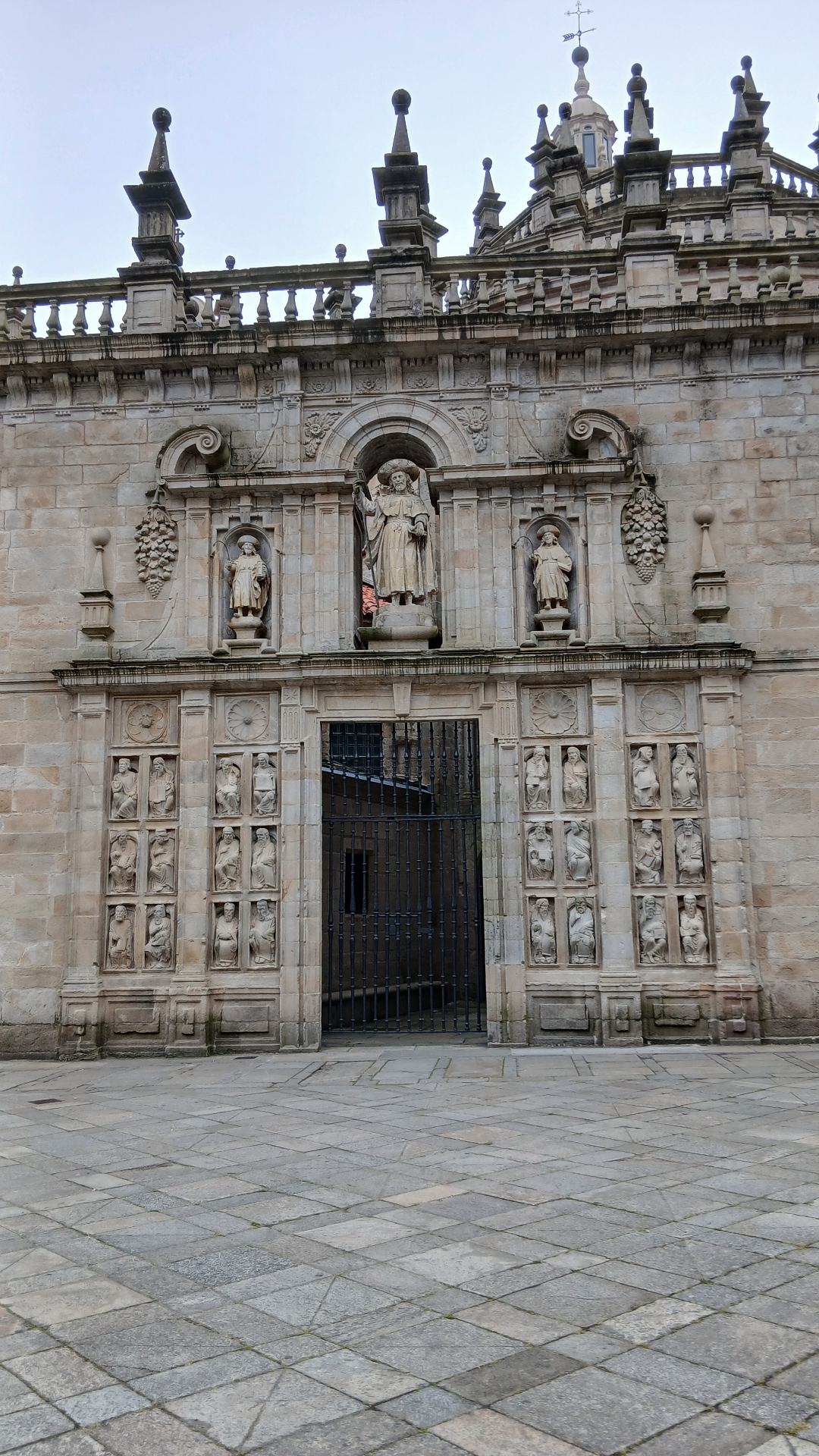
There is a door in Santiago de Compostela that spends most of its life sealed. It sits on the eastern flank of the cathedral, facing the quiet stone theatre of the Praza da Quintana, and for years at a stretch it is simply wall — mortared shut, unremarkable, easy to walk past without a second glance. Then, once every six years, or five, or eleven, depending on where the calendar falls, the Archbishop of Santiago raises a silver hammer and strikes it three times. The mortar gives way. The door opens. And for the next twelve months, the ancient rhythm of the Camino de Santiago changes entirely.
On 31 December 2026, that hammer will fall again. 2027 is a Xacobeo — a Holy Year, or Año Santo — triggered by nothing more mystical than a calendar coincidence: the Feast of Saint James, 25 July, falls on a Sunday. It happens on a pattern of six, five, six and eleven years, which means true Holy Years arrive only fourteen times a century. The last one, in 2021, was extended into 2022 by a pandemic that emptied the routes just as the doors opened. Twenty-twenty-seven carries no such asterisk, and the numbers on record from previous Holy Years suggest what is coming.
In 2010, the last Holy Year to run its natural course, the Pilgrim's Office issued 272,703 Compostelas — an increase of almost 87% on the year before. In 2022, the pandemic-postponed continuation of the 2021 Xacobeo, the figure reached 438,209, itself a record at the time. Neither of those Holy Years arrived on top of the baseline the Camino now has. In 2025 — an entirely ordinary year, with no Holy Door open — the Pilgrim's Office recorded 530,987 Compostelas, the highest total ever registered outside a Xacobeo. That is the platform 2027 is being built on: a route already running at record volume, about to be handed the one event that has, without exception, driven every prior baseline sharply higher. It is, by every measure the Camino keeps, expected to be the largest Holy Year in the pilgrimage's modern history.
What a Holy Year actually does
To understand why this matters — to Santiago, to Galicia, to the hospitality economy strung along eight hundred kilometres of waymarked path — it helps to understand what a Holy Year is for. Since 1211, when Pope Calixtus II first granted the privilege, pilgrims who enter Santiago Cathedral during a Xacobeo year, pray, confess and take communion within a fortnight of their visit, receive what the Church calls a plenary indulgence: full remission of sin. It is one of only a handful of such privileges in the Catholic world, and it is available nowhere else, at no other time. For the faithful, that scarcity is the entire point. For everyone else — the walkers, the cyclists, the curious, the culturally devout rather than the doctrinally so — the Holy Year has become something broader: a once-in-a-decade cultural season, when Galicia stages concerts, exhibitions and civic celebrations that don't happen in ordinary years, and when the whole apparatus of the Camino — its albergues, its way-markers, its infrastructure — is renewed and reinforced in anticipation.
The Spanish government has already designated Xacobeo 2027 an Event of Exceptional Public Interest, unlocking funding and coordination that a normal tourist season never sees. Galicia's regional government invests accordingly: restored path sections, expanded services, upgraded signage — the quiet civil engineering that turns a trickle of walkers into a manageable flood.
Not just Santiago — every road that leads there
The word "Camino" suggests a single path, and the postcard imagery — the scallop shell, the cathedral's twin baroque towers — tends to fix the imagination on Santiago alone. But the Camino has never been one road. It is a network: the Francés threading in from the Pyrenees through Burgos and León; the Portugués rising up the Atlantic coast from Lisbon and Porto; the Norte tracing the cliffs of Cantabria and Asturias; the Inglés arriving by sea at Ferrol and A Coruña; the Vía de la Plata running the old Roman silver road up from Seville. In a Holy Year, every one of these routes swells — not evenly, and not identically, but unmistakably. The surge doesn't arrive in Santiago on 25 July and disperse. It arrives village by village, month by month, from the first pilgrims crossing the Pyrenees in January to the last stragglers seeking the Holy Door's final blessing in December.
This is the detail that visitors — and casual observers of the Camino's economics — most often miss. A Holy Year isn't a single-city event with a long approach road. It is a distributed one, and its economic footprint runs the full length of Galicia and beyond, through towns whose entire tourism calendar reorganises itself around twelve unusually intense months.
A gap that has been growing for years
Accommodation along the busiest stretches, and around the cathedral itself, tightens months in advance in any Holy Year; the travel trade serving the route is already advising clients to book 2027 dates now, more than a year out, an unusual degree of lead time for a pilgrimage historically associated with turning up and walking. Every operator, tour company and diocesan office watching the run-up to 2027 is saying some version of the same thing: this will be the biggest Xacobeo the modern Camino has seen, arriving into a hospitality market that, across much of rural Galicia, was not built for it.
That gap — between demand that has been building, verifiably, for two decades, and a regional accommodation stock that has grown far more slowly — is where the opportunity sits.
Where ABIS fits into the year the doors open
ABIS Investment Group's Galician portfolio was not assembled with Xacobeo 2027 as its premise, but the timing is difficult to overlook. Hotel Lusco sits in Viveiro, on the Mariña Lucense coast — a town whose place on the Camino is older than the more famous inland routes it now feeds into. Long before the Camino Norte drew pilgrims through the interior, Viveiro was one of the principal waypoints on the Camiño do Mar, or Camino del Mar: the coastal Jacobean route running from Ribadeo to Ferrol, documented since the fifteenth and sixteenth centuries and once served by as many as six pilgrim hospitals in Viveiro alone. That history is not decorative. The Camino del Mar remains, today, one of the least-served routes to Santiago — a handful of albergues along its full length, one of them in Viveiro itself — which means the accommodation shortfall that a Holy Year exposes elsewhere in Galicia is, on this stretch of coast, already the everyday condition. A property positioned in Viveiro sits at one of the few genuine beds on a route that history, and a growing number of pilgrims rediscovering it, keeps pointing back towards.
Nova Ruta, in Vilalba, sits within the same northern catchment, on ground where the Camino Norte and the routes feeding in from the coast converge before continuing on to Santiago. Edificio Vilalba, a mixed-use conversion anchored by a long-term commercial tenant, adds a different kind of resilience to the same corridor.
None of these properties depend on Xacobeo 2027 to justify their place in the portfolio. But a Holy Year is, by its nature, the one predictable demand event the Camino offers — flagged years in advance, backed by government infrastructure spending, and certain, on current form and on the record of every Holy Year before it, to be the largest such season in living memory. For investors weighing entry into Galician hospitality real estate, the Holy Door does not open often. It is opening again in five months.
This is presented as a fractional hotel investment opportunity within the ABIS portfolio — a route to holding a share in the accommodation itself, not a booking for a night's stay. Those interested in the detail are welcome to make contact directly.
Hotel Lusco, Nova Ruta and Edificio Vilalba — positioned on the routes leading into Xacobeo 2027.
This article was prepared for ABIS Investment Group.