
Every great Spanish property story started the same way: tourists arrived, hotel rooms filled, room rates climbed, and the people who owned the beds got rich. It happened on the Costa del Sol. It happened in the Balearics. It happened in Barcelona and San Sebastián.
There is one stretch of Spanish coast where that story is only just beginning — and a single date on the calendar is about to accelerate it. This is the case for getting into Galician hotels now, while the door is still open.
The Coast Is Where Spain Made Its Money
Spain welcomed a record 96.8 million international tourists in 2025 — the second most-visited country on earth — and earned roughly €135 billion from them (INE). That demand landed on the coast, and the coast rewarded its owners.
San Sebastián, on the cool Atlantic north, is now the most expensive city in all of Spain at around €6,250 per square metre. The Balearics sit above €5,000, Barcelona near €4,990, and the Costa del Sol set a record of about €3,842/m² after climbing nearly 14% in a single year (idealista, 2025). Whoever bought early on each of those coasts is now sitting on a mature, expensive market.
Galicia Is the Same Coast — at a Fraction of the Price
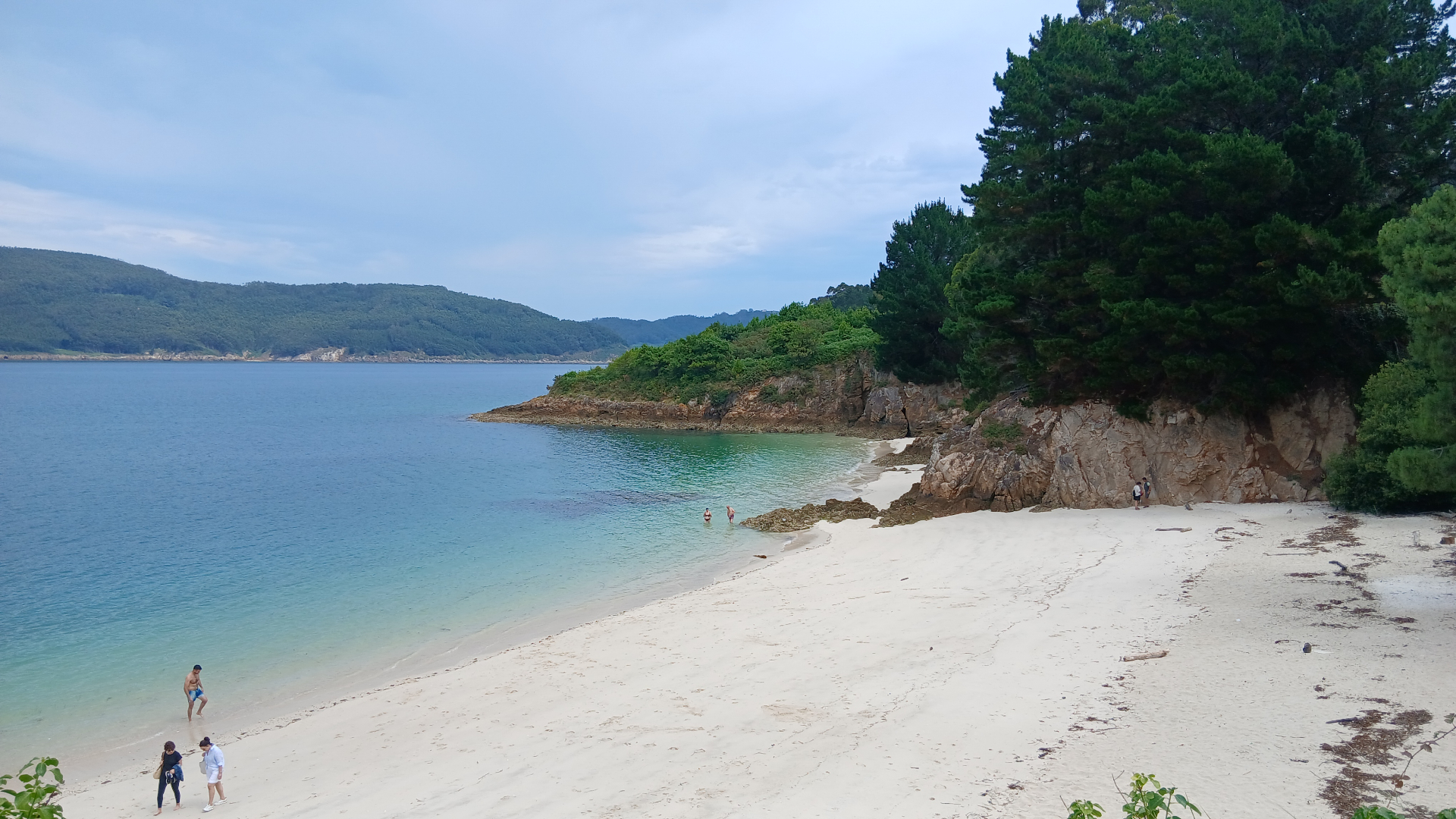
Galicia has the longest coastline of any region in Spain — around 1,500 kilometres, close to a fifth of the entire national total, with 772 beaches and dramatic Atlantic estuaries. No other region offers more shoreline, and none offers it more cheaply.
| Coastline | Approx. €/m² (2025) |
|---|---|
| San Sebastián (Basque) | €6,250 |
| Balearic Islands | €5,070 |
| Barcelona | €4,990 |
| Costa del Sol (Málaga) | €3,840 |
| Costa Blanca (Alicante) | €2,595 |
| A Coruña (Galicia) | €2,900 |
| Galicia — regional average | €1,960 |
Galicia is comfortably the cheapest of Spain's major coastlines — and buyers are already moving. Property sales jumped 22.3% in 2024, the second-highest rise of any Spanish region. Demand is arriving faster than the prices have caught up — precisely the moment an investor wants to enter.
The Hotel Engine Is Running at Record Power
Spain's hotel industry has never been more profitable. In 2025 the sector hit all-time highs across the board: 75.5% average occupancy, €166 average daily rate, €125 RevPAR — up more than 5% in a year (STR / Cushman & Wakefield). Spain's room-rate growth left the rest of Europe far behind. Even a standard four-star room now earns around €120–€125 a night, every night it's sold.
Galicia is plugged straight into this engine — and, crucially, it is under-supplied. The region draws enough visitors to rank fourth in Spain for the number of hotels, yet only seventh for the number of rooms. More demand than beds. In Santiago de Compostela, summer occupancy already runs around 80%, with the best hotels pushing 90% in August. Rooms in the historic centre fill many months ahead, and along the Camino the better accommodation now books 12 to 18 months in advance.
The coast has the visitors. What it lacks is rooms — and that gap is the opportunity.
Xacobeo 2027: The Catalyst That Doubles Everything
Here is the date. 2027 is a Holy Year — a Xacobeo — and it is the single most powerful event in the Galician calendar.
A Holy Year occurs only when the feast of Saint James, 25 July, falls on a Sunday. Because of how the calendar turns, it happens just 14 times in a century. During the year, the Cathedral of Santiago opens its Holy Door — the Porta Santa, sealed shut in every ordinary year — and pilgrims who pass through it can receive a plenary indulgence. It is, quite simply, the reason pilgrims time their entire journey for these specific twelve months.
And Holy Years do something remarkable to the numbers: they double them. In 2003 the Camino drew 74,000 pilgrims; the 2004 Holy Year pulled 180,000 — well over double. In 2009 it drew 147,000; the 2010 Holy Year leapt to 272,000 — almost double again (Pilgrim's Reception Office).
Now layer that pattern onto today's baseline. 2025 — an ordinary, non-Holy year — already set an all-time record of 530,987 pilgrims, up 6% on 2024, and that figure only counts those who walk the final stretch and collect their certificate; the true number on the routes is estimated to be up to 40% higher again. There is also a wave of pent-up demand: the last Holy Year, 2021, was smothered by the pandemic, and the pilgrims who missed it have been waiting five years for 2027.
The conclusion writes itself. If 2027 follows the pattern of every modern Holy Year, Santiago will welcome close to a million pilgrims — roughly double a record year, in a city whose hotels are already running at 80–90% in summer. The Galician government and the Church have declared 2027 an Event of Exceptional Public Interest and are investing heavily in infrastructure and a year-long cultural programme. The wave is not a hope. It is scheduled, dated, and already being prepared for.
The Climate Is Handing Galicia the Future Too
The timing is even better than the calendar suggests. As southern Spain bakes under 40–46°C summers — to the point that the country now orders terraces closed during heatwave alerts — travellers are heading north for what the industry calls a coolcation. The European Travel Commission found in 2025 that 81% of Europeans are adjusting their travel because of the changing climate.
Galicia's summers are a comfortable 20–25°C: warm enough for the beach, cool enough to enjoy it all day. Bookings across the green north are rising as the south overheats. What was once Galicia's drawback is now its edge — and that tailwind strengthens every single year.
The Train Is Leaving — This Is the Platform
Line up the facts. The cheapest major coastline in Spain, with more shoreline than any other region. A hotel sector at record profitability, in a region that has more visitors than beds. A once-in-a-decade Holy Year in 2027 on track to double pilgrim numbers toward a million, in a city already running near full in summer. And a warming continent permanently redirecting travellers toward exactly this kind of cool, green coast.
The investors who waited too long on the Costa del Sol or in San Sebastián paid record prices for the privilege. Galicia is the same proven formula, at the start of the curve instead of the end — but the window is the narrow part. Hotel rooms for 2027 are being booked now, in 2026. The assets are still cheap today; they will not stay that way once the Holy Year crowds arrive and the rest of the market does the maths.
The hotel investment train is at the platform in Galicia. It does not wait for 2027.
Connecting serious investors with serious opportunities across Spain and Europe.
Sources: INE, idealista, STR / Cushman & Wakefield, Pilgrim's Reception Office, European Travel Commission — 2024/2025. Figures are indicative and provided for general comparative purposes.